
Choose from a wide range of training rigs.
We have helicopters, to ships, to wind turbines.
If you require something a little more bespoke then speak to our design team for a proven solution.

Our STCW fire training rig is a modular, containerised system designed to deliver realistic and controlled maritime emergency response training. Constructed from steel ISO containers, Our rig replicates key onboard environments including accommodation areas, galley, engine room, control room, and confined space zones. All fire scenarios are powered by LPG systems, providing consistent, repeatable flame behaviour without the risks associated with traditional Class A materials. Synthetic smoke is integrated throughout to simulate reduced visibility and enhance realism.
Our structure incorporates multiple access points, external walkways, and stair systems with full handrail protection to ensure safe trainee movement. A central bridge houses our instructor controls, CCTV monitoring, and system management, with mirrored control capability in a secondary room for redundancy. Our rig supports a wide range of STCW-compliant training exercises, including fire response, confined space entry, communication, and team coordination, all within a safe, controlled, and environmentally responsible training environment.

We have many options the one above is the s92 , this one however is designed so that you can turn the rig 180 degrees in extreme wind conditions.
Our S92 helicopter fire training rig is a fixed, ground-based aviation simulator designed and built for use at UK aerodromes. It is designed to meet the requirements of CAA CAP 168 and CAP 699, and aligns with ICAO Annex 14 and ICAO Doc 9137 for aviation fire training facilities.
Our simulator delivers realistic training scenarios including engine, nacelle, cabin, cockpit, undercarriage, and fuel spill fires, along with emergency access, rescue, and casualty extraction representative of a Sikorsky S92 configuration.
All LPG and diesel pressure-fed fire systems are designed, installed, and commissioned by certified professionals and are compliant with DSEAR 2002, incorporating controlled ignition, emergency shutdown, isolation, and ventilation systems.
Our structures are fabricated to BS EN 1090 and ISO 3834 standards, with consideration for structural integrity, environmental exposure, and durability. The rig is designed to comply with airport regulations and provides a safe, robust, and repeatable training environment aligned with UK aviation firefighting standards.

Compartmental Fire Behaviour Training was introduced in the 1980s and has since been widely adopted by Fire & Rescue Services in the UK and internationally. Our STCW training rig builds on these principles by replicating, as realistically as possible, the behaviour of fire gases within enclosed compartments. This enables trainees to safely experience the effects of well-ventilated and under-ventilated fire development, rapid changes in burn rate, and key fire phenomena such as flashover and backdraft, within a fully controlled environment.
Constructed from steel ISO containers, our modular rig recreates essential onboard spaces including accommodation, galley, engine room, control room, and confined space areas. All scenarios utilise LPG-based fire simulation combined with synthetic smoke to deliver consistent, repeatable training without the risks of traditional Class A materials.
We actively consult with current instructors and industry professionals to ensure our rigs provide a safe training environment that meets all required standards and achieves the specific training objectives identified in any bespoke client request
.

We have many examples of training rigs that are specific for the relevant training scenarios. Should your requirements be to fulfil the requirements of GWO, City in Guilds or JOIFF, please do not hesitate to get in touch where we would be happy to discuss a solution.

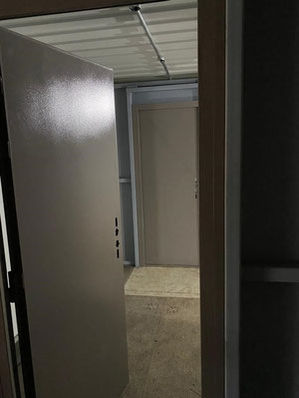
This training rigg can be heated up and filled with synthetic smoke. There is a warren of rooms over three floors built in kit form from 6 x 40ft containers with interconnecting security doors.
2 x internal staircases and ladders with inertia points. We have also provided an outside floor area and stair case on the out side that will give the students the scenario of descending into basements
For confined space work we have included a crawl area that can be interchanged to vary routes to make it as difficult or easy as you would like. We have also provided a vertical confined space area to enhance the training experience.

Demonstrator Units are designed to provide a safe demonstration and learning environment with the ability to initiate and sustain a carbonaceous fire. By controlling the release or containment of fire gases this will accurately simulate fire behaviour and development of a fire event.
Instructors can demonstrate the principles of combustion and compartment fire behaviour, how a fire develops and spreads and the appropriate action.



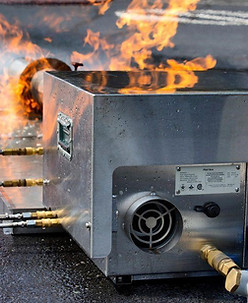
All training rigs are designed with and installed by fully qualified commercial Gas Safe engineers holding ACS certification, ATEX awareness, and hydrogen fuel competency. LPG systems are required to deliver safe, controlled, realistic live-fire emergency response training environments.
Fabrication is undertaken by our coded welders holding current BS EN ISO 9606 qualifications, supported by approved WPS and QA/QC procedures.
All gas systems will be designed, installed, tested, and commissioned by fully qualified commercial Gas Safe registered engineers holding current ACS commercial gas certifications relevant to LPG, pressure-fed fuel, and industrial gas installations.
All pressurised fuel systems associated with the training rig will be designed, installed, tested, and commissioned by suitably qualified and competent engineers experienced in industrial fuel, LPG, and live-fire training systems, in accordance with applicable safety regulations and industry standards.